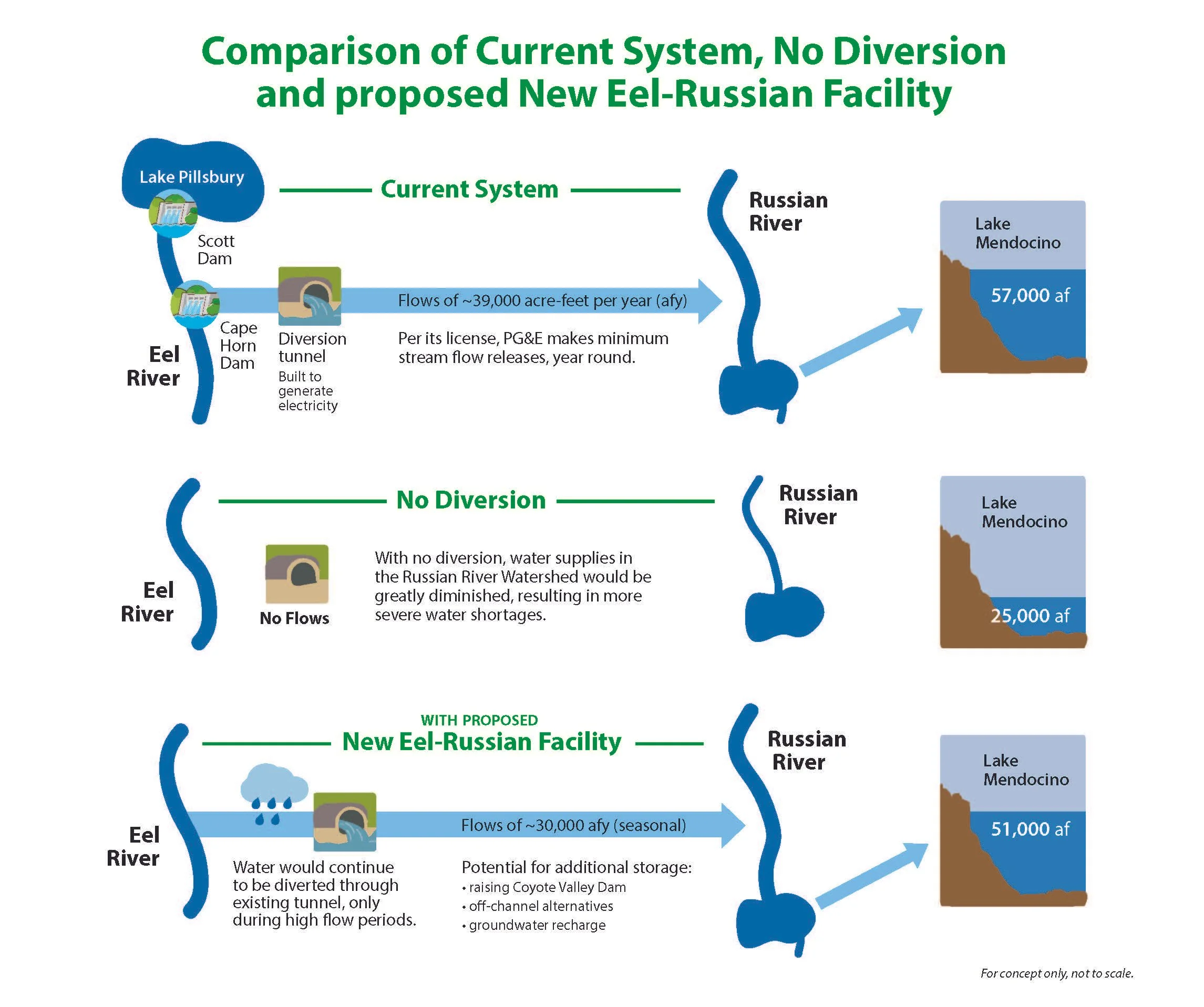
How Future Eel River Diversions Might Affect Russian River Water Supply
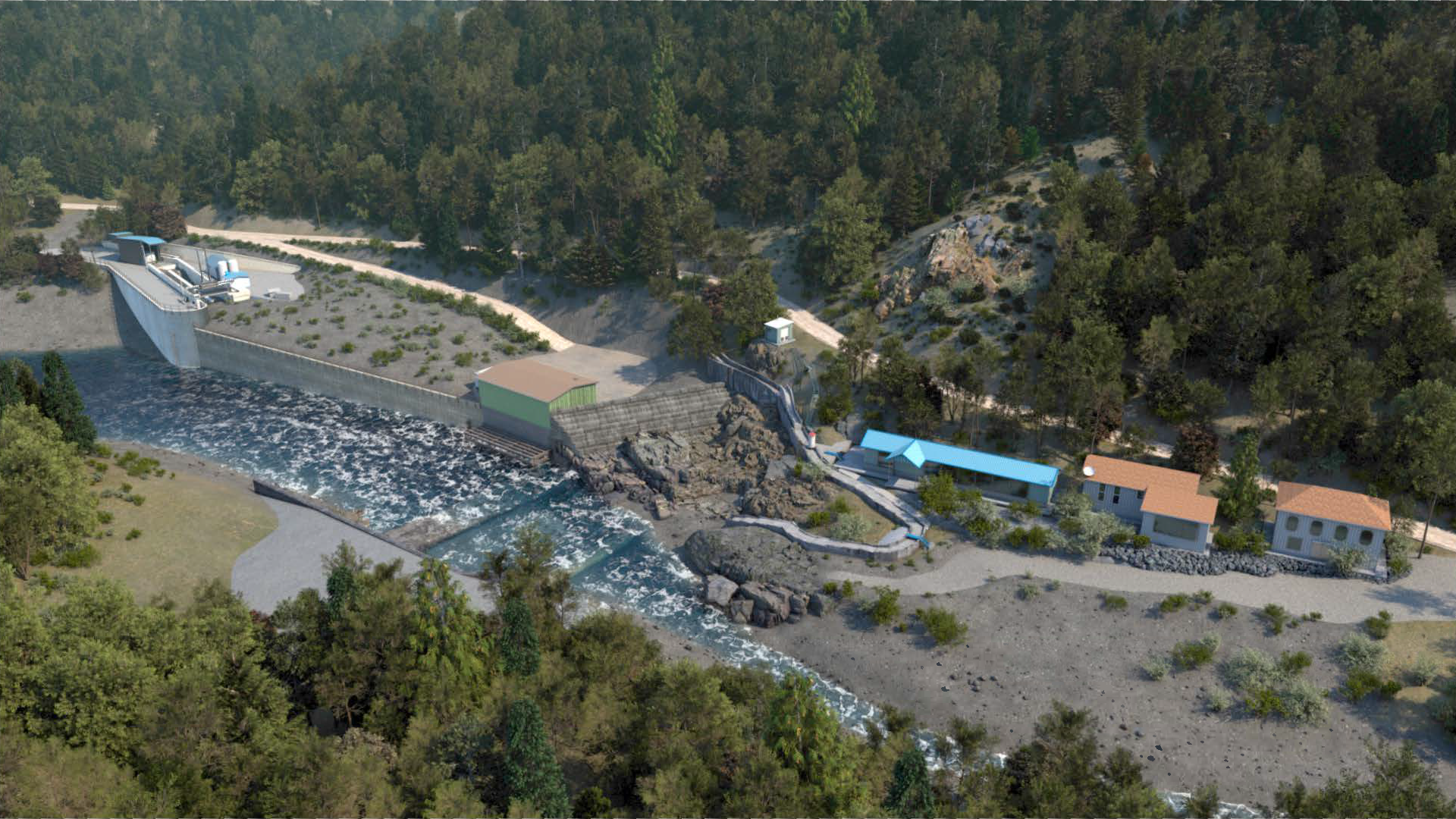
Once PG&E removes Cape Horn Dam, the New Eel-Russian Facility will continue to support water supply resiliency in the Russian River watershed by maintaining diversion of water from the Eel River during wet seasons for storage and use during the dry season. Diversions would be undertaken so as not to affect the Eel River’s ecosystem.
Maintaining seasonal diversions of Eel River water to the Russian River and Lake Mendocino would preserve the water supply for hundreds of thousands of people in Mendocino, Sonoma and Marin counties, as well as supporting agricultural uses, wildlife, riparian habitat and sensitive ecosystems along the Russian River.
New Eel-Russian Facility: Operational Overview and Diversion Capacity
Location
The new diversion facility will be built at the former Cape Horn Dam site, which will be removed as part of PG&E’s Potter Valley Project decommissioning process.
Diversion Infrastructure
The facility will include a pump station which will operate seasonally during high flow in the Eel River (during wet seasons — fall, winter and spring). The pump station will convey water into the existing diversion tunnel, which has a capacity of approximately 300 cubic feet per second (2,244 gallons per second, equivalent to about 595 acre-feet per day).
Estimated Annual Diversion Volumes
Computer modeling indicates that under typical wet-season conditions, the facility can reliably divert up to 50,000 acre-feet/ year. Depending on rainfall levels and Lake Mendocino storage capacity, diversion volumes up to 30,000 acre-feet/year are anticipated.
Historical Diversions via PG&E’s Potter Valley Project
Between 1922 and 2005, PG&E diverted an average of approximately 150,000 acrefeet/year from the Eel River to the Russian River basin. An acrefoot is 325,851 gallons of water — enough to cover one acre of land with one foot of water.
From 2007 to 2020, annual diversions decreased to approximately 60,000 acrefeet/year due to changes in PG&E’s operating license issued by the Federal Energy Regulatory Commission.
Since 2021, diversions have further declined to a range of 30,000–40,000 acre-feet/year due to failing infrastructure and seismic risks associated with Scott Dam.
Storage Capacity and Operational Constraints
Lake Mendocino Storage
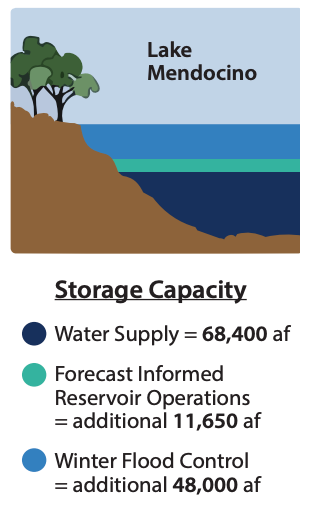
Lake Mendocino’s maximum water supply storage capacity between Nov. 1 and March 1 is 68,400 acre-feet. Based on ForecastInformed Reservoir Operations (a water supply management strategy using advanced watershed monitoring and weather and water forecasting), the U.S. Army Corps of Engineers may, at its discretion, retain an additional 11,650 acre-feet of water, increasing total seasonal storage to 80,050 acre-feet between Nov. 1 and March 1, with a further increase to 111,000 acre-feet on May 10.
Under typical wet-season conditions, and dependent on Lake Mendocino storage capacity, diversion volumes up to 30,000 acre-feet/year are anticipated.
Potential for Future Additional Storage
The U.S. Army Corps of Engineers, with local sponsors Mendocino County Inland Water and Power Commission and the Lytton Tribe, is evaluating the potential of increasing storage in Lake Mendocino by raising the Coyote Valley Dam. Additional feasibility studies are examining off-channel storage alternatives and groundwater recharge opportunities within the Potter Valley area and along the East Fork of the Russian River.
Impacts of No Diversion
With no diversion, water supplies in the Russian River Watershed would be greatly diminished, affecting agriculture, fire suppression, ecosystems, recreation and drinking water supply, and pose a serious risk of Lake Mendocino draining in drought years.
Decommissioning and construction timeline
The timing of PG&E’s removal of Cape Horn Dam is contingent upon the Federal Energy Regulatory Commission’s issuance of a Surrender Order and completion of associated environmental studies. The Eel-Russian Project Authority, a Joint Powers Authority, is responsible for the design, permitting, construction, operation and maintenance of the new diversion facility — the New Eel-Russian Facility.
Construction of the facility will take place simultaneously with the dam removal, minimizing disruption to water diversions and ecological impacts to the Eel River. The design and permitting phases of the New Eel-Russian Facility are expected to span several years, with concurrent regulatory and technical reviews guiding final implementation.
Project Schedule